
Presidential Range Traverse
by Jackson O'Brasky

Today’s post is the first in a series of guest posts. Presidential Range Traverse is a dispatch from Jackson O’Brasky. A talented painter and thinker that I have known basically since I moved to New York almost a decade ago. We shared a studio for years and for three days I walked the Appalachian Trail with him. This writing is not about those three days.
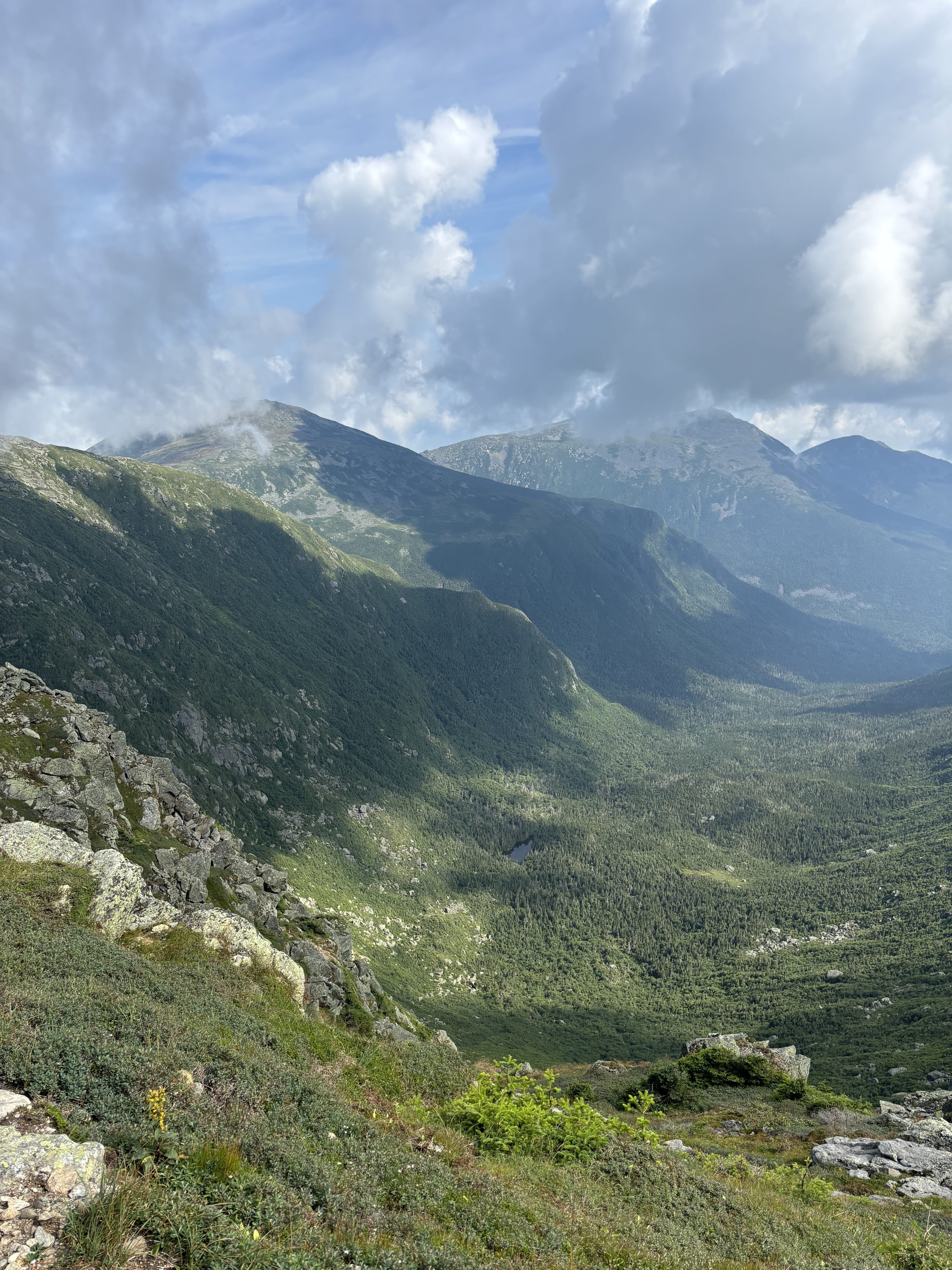
When I reached the camp it was nearly dark. I had not traveled particularly far that day but the terrain had been difficult. I started at the bottom of a valley and went directly up the steep backside of Franconia Ridge, clockwise over Lafayette to Mt. Garfield. The weather in the White Mountains is crazy, mostly because of the topography of the surrounding ranges. All day a cloud had pushed up against the ridge, only to break against it and roll back. To my left, there was a cloud so close I could touch it. To my right, open air.
The trail was rocky, steep and soaked in rain. Occasionally, near the summit of Lafayette, I was passed by small groups of Orthodox Jewish women in windbreakers and running shoes.
I began to relax.
The women regarded me curiously. At camp, most of the hikers I knew personally. Some I had traveled with for months, and others I had met at a hostel the night before. A storm was moving in and I was exhausted. The caretaker asked me if I knew the hiker who went by “Widowmaker.” What kind of woman would call herself that, he wondered? Your name often determines your character. Apparently she hadn’t thought so and they had had some disagreement. Not wanting to get involved, I paid the man his fee and went off to cook my dinner. I made Annie’s Shells in White Cheddar, with mayonnaise, powdered milk, and bacon bits. Lightning was striking above the treeline, not far away. You did not want to press your luck in the White Mountains.
Franconia Ridge was open and treeless, but in a few days we would traverse the Presidential Range, a long stretch of alpine ridgeline exposed to some of the worst weather in the world. I had hiked it before, when I was a child. Now, I was nearing the end of a thru hike, walking the length of the Appalachian trail from Georgia to Maine. I was feeling humble. It was very difficult and the sudden changes in the terrain were confusing, sometimes frightening, but this made everything seem more significant and real. This was why I was out there.
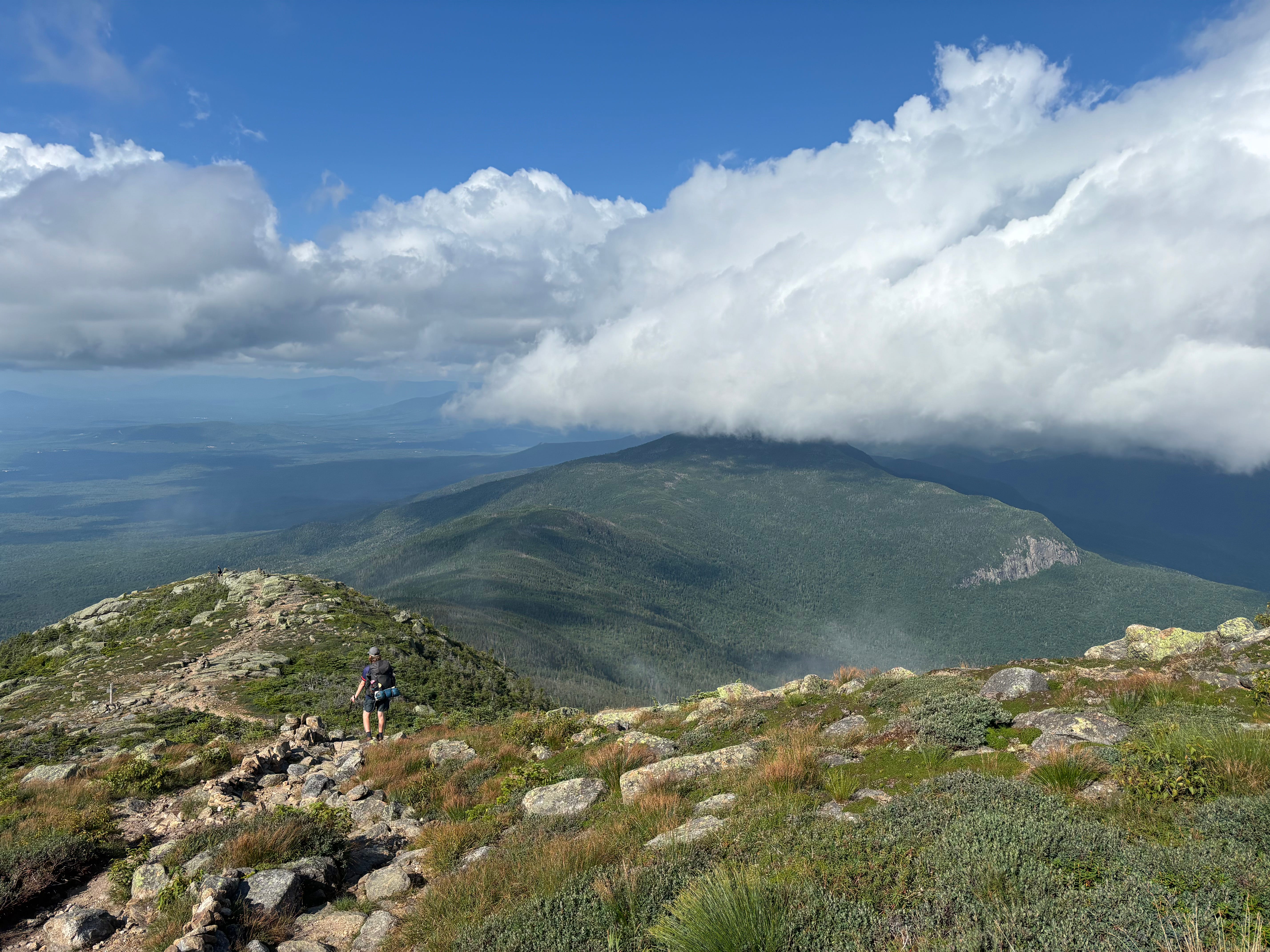
The next day, the trail down Garfield had turned into a waterfall. Outlaw and I looked at it dumbfounded. Water poured over rocks, down into a forest and an impenetrable mist, pouring out of the world. Outlaw muttered “fuck it,” and I followed him. A few weeks ago in Vermont, two southbound hikers had laughed when we asked them about The Whites. “The stairmaster,” one called it. “Were you ever exposed? Like, dangerously?” I asked. The hikers paused. “No, never,” one of them said. “But a bunch of times we were in a cloud, and it really does look like you’re about to descend a cliff into nothing. Into a void.” It was shocking how steep the trail could get. Descending Mt. Moosilauke, I reached a sheer rock face that was helpfully festooned with wooden boards, for your hands and feet. The ladder stretched twenty feet down. I had to turn around and look in another direction for about thirty seconds before I went on, feeling sick with fear. On Mt. Garfield, we descended carefully through pouring water for about an hour. Then the weather cleared and the rest of the day passed smoothly. I pitched my tent in the smoothest patch of earth I could find. After two more days, we passed Crawford Notch and gained the Presidential Range.
The Appalachians are old mountains, and not very tall. Out west, in the Rocky Mountains or the ranges of the American Cordillera, peaks can frequently pass 14,000 feet above sea level– young mountains. In the east, peaks above 4,000 feet are coveted. With much of the north east’s public land covered in second-growth forest, expansive views above treeline are rare. These views are the reward for a hard climb through the Green Tunnel. This is the mystique of the Whites, which has great big spaces above treeline– and so the trails were built to make the hiker earn them. You can see the Yankee mind at work there. The mindset prevails the further north you go on the American trail system– in the Adirondacks, Vermont’s Long Trail, and deep into Maine. The effect works, even if you don’t believe in it.
My dad had taken my brother and I on our first hiking trip when I was about thirteen. We had intended to hike the Presidential Traverse, but only finished about half of it. I hated the experience right away. I had never exercised before in my life and was in pain. I had to catch my breath every fifteen minutes of our ascent, and I could tell my family was getting impatient with me. When we got above the treeline, my bad feeling dissolved. Maybe I was somehow predisposed to this kind of reaction, but looking west from the ridge, I was awed. The effect of space and light on the mind can be profound.
The experience probably put me off hiking for a decade and a half, but the feeling must have stayed with me, embedded in my memory. In retrospect I see it in my fascination with landscape paintings, the pastoral themes I’m obsessed with, the music I like. When I rediscovered hiking in my late twenties, it was like being reunited with a long-lost friend, or even a partner. You thought she was dead! Whatever their reasons, it doesn’t matter. You are together again.
When my cousin completed the Pacific Crest Trail, I realized some people do really drop everything and hike for months. One day it occurred to me that I had to try it myself. I had no choice. I slowly acquired the gear, which added to the urgency. I had to actually use all this shit. I started to obsess over the Appalachian Trail in particular. This was the first American long trail, and one I had walked before, in pieces, without realizing it. The east was my home, New England especially, and one of the most important facts of my home was the chain of mountains that had defined patterns of settlement there for tens of thousands of years. Then one day in early March I was stepping off a train in Georgia and began to hike north.
The first day on the Presidential Range was a disappointment. I reached the hut where my father and my brother and I had stayed our first night out, essentially a hostel in the woods, and ate one of the pastries the crew had baked. I thought about the night we had spent there, how we had reached it just before the end of the evening meal, exhausted after taking the wrong trailhead, and how the thin soup had tasted like the best and most necessary meal I had ever had. Then I was retracing those steps towards Mt. Washington, eager to see the view that had affected me as an adolescent, but the ridgeline was clouded over and visibility had dropped to about twenty feet. I thought I recognized certain portions of the trail, but it really could have been any deranged jumble of rocks and pools, and eventually the wind picked up and I focused on staying upright. I wondered where my father was. He didn’t know I was doing this and probably wouldn’t have cared– we hadn’t spoken in seven years.
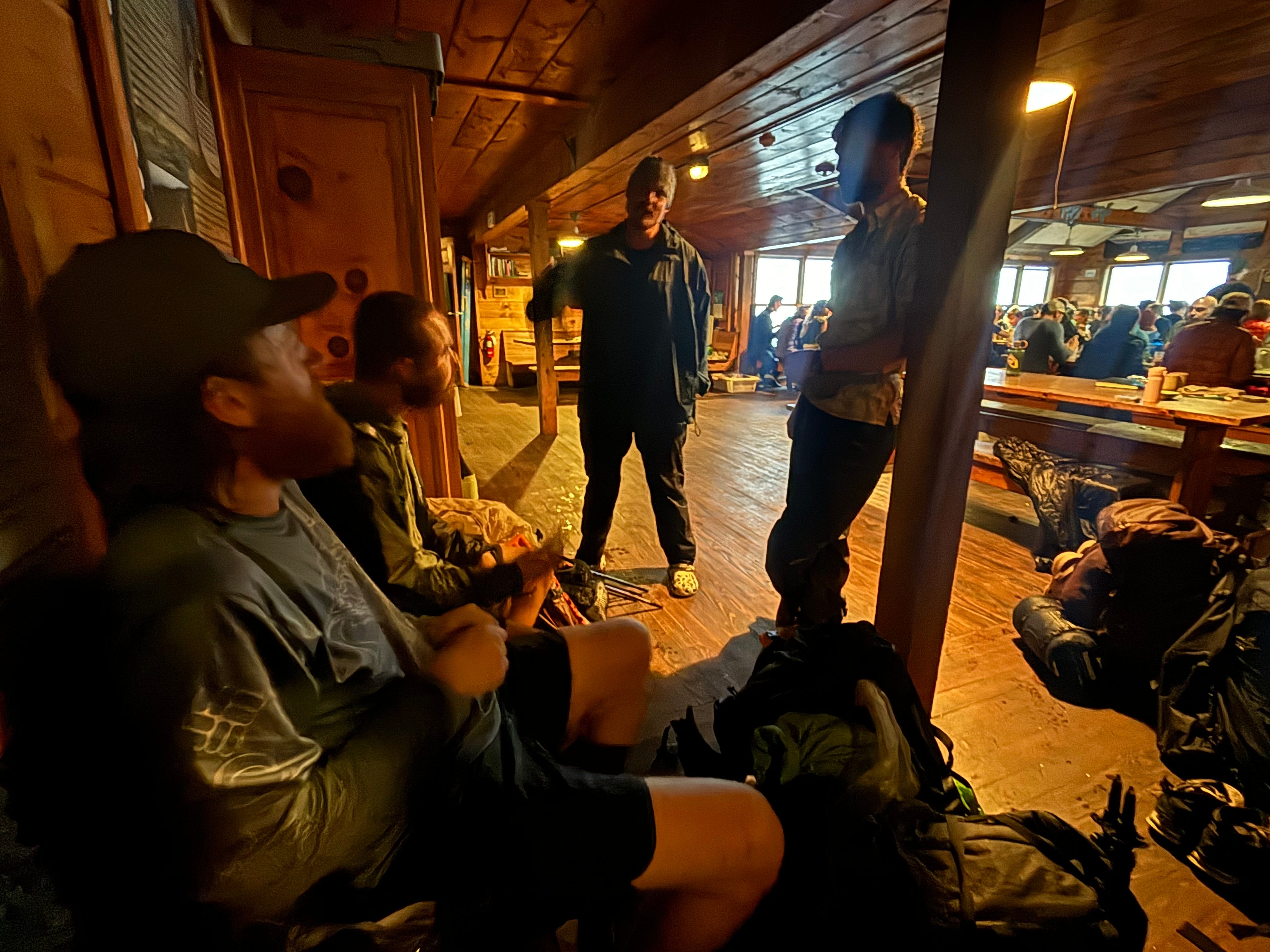
Visibility dropped further. Peaks I thought I recognized turned out to be knee-high bushes. The hut, once completely invisible, appeared suddenly to be ten feet away. I stepped from the howling wet gale into a loud, dimly lit dining hall crowded with backpackers and asked the two college students at the desk if I could work in exchange for a spot sleeping on the dining room floor. It would have been too dangerous for them to send me back out so late in the day, so the crew agreed. The night passed beautifully. When a group of cold, soaking wet hikers are allowed inside of a heated room and they realize that they can spend the night there, they reach a state of collective elation. After the paying customers had been served, we were given plates of pasta. We ate standing up, exulting in the pleasure of our dry changes of clothes and the warmth of a room with two hundred people inside of it. The hut is called Lake of the Clouds and it sits by a few ponds in the col between Mt. Monroe and Mt. Washington. The dining hall and kitchen sit between several bunkrooms and chemical toilets on the other side, and the hall is lined with windows, giving the impression of being on a blimp or a spaceship, or perhaps a submarine when the clouds interfere. White Claw and Hero had been there for a whole day when I arrived and I hadn’t seen them in a month. Outlaw had a few cartons of wine and we passed them around and played farkle. It was a happy reunion, the end of a difficult day. Tomorrow was going to be even longer, and the descent off of the Presidential Range was a scramble down a steep talus field. First we would climb Washington. I took a benadryl and laid my sleeping pad on the floor. I woke up in a clear blue sky, the sun only beginning to touch the east side of the ridge. The clouds had blown far off, and the front pushing in from the west would take hours to reach us. I looked at James and Tin Man and Cinderella and said, “This is going to be a great day.”
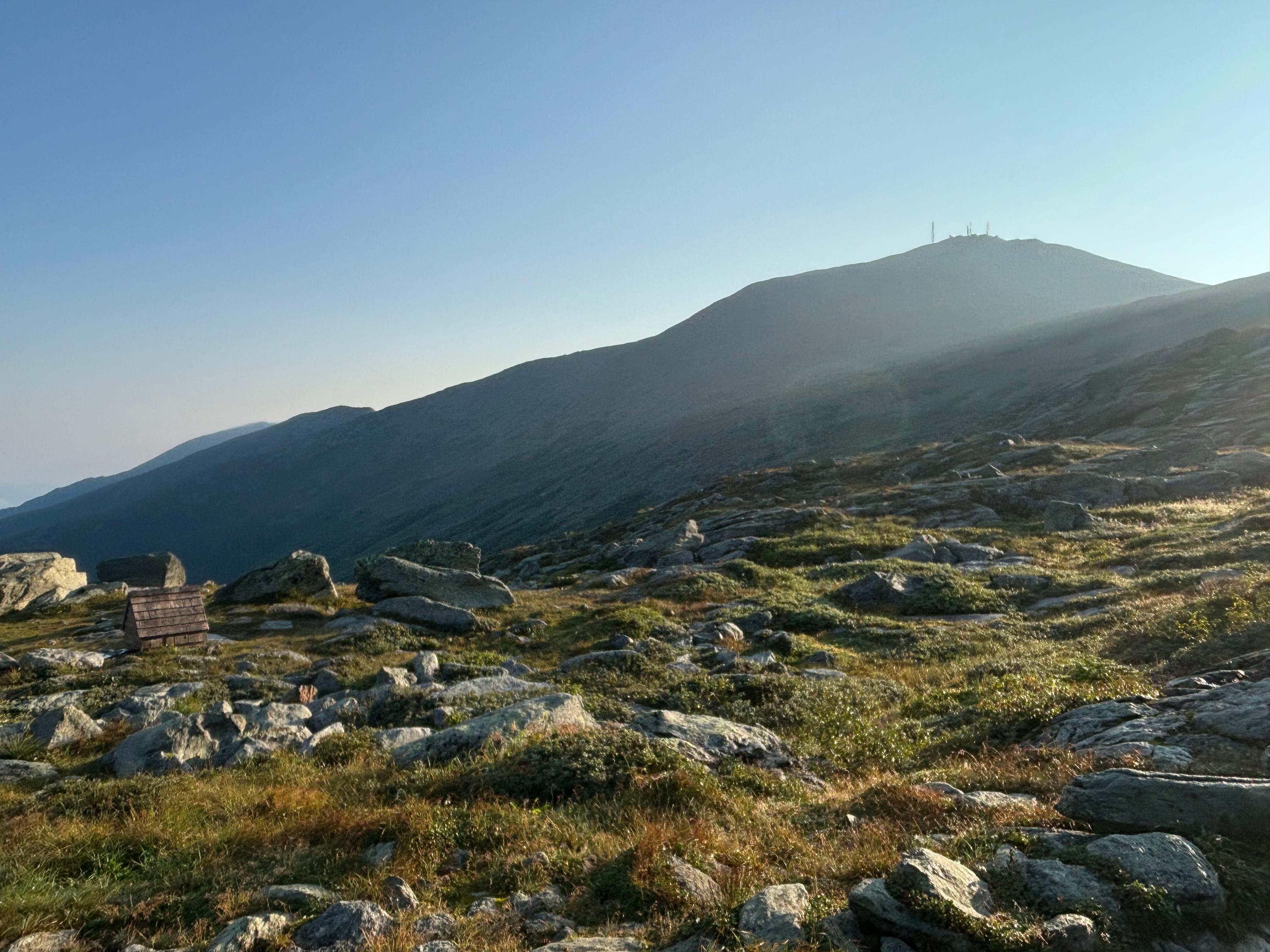
The first time I ever climbed Mt. Washington, the mountain was covered in a cloud. We had decided the day before that we would abandon the rest of the hike and I was relieved. On the way back to the car I was in so much pain I started weeping– I was not a healthy kid. I returned to a diet of video games and processed snacks. Like I said, I came back to hiking later, in my late twenties, no longer young. This was bittersweet. Youth is a great asset to a hiker, and it can’t be replaced. Of course, it was also a happy reunion, because something had been missing from my life which I badly needed, and I had figured out what it was. Looking back, I remember times in my twenties where I had brought up hiking apropos of nothing. “What should we do today,” my friends would ask. “Do you want to go for a hike?” I would reply. We had never done anything like that and never would. I was fascinated by the Hudson River Valley School, by Tom Thomson and the Group of Seven. The artist needs nature, or, at least, I think I do. I need the exercise, I need to be part of the environment, and the environment needs to work itself into my art– interpenetrating ecologies. A cycle, like water. The second time I summited Washington, the front was moving closer, the water cycle in living detail. The sun exploding overhead. On this summit, the fastest wind ever recorded by human instruments. I kept laughing and repeating, “This is going to be a great day.” And I tell you, it was.
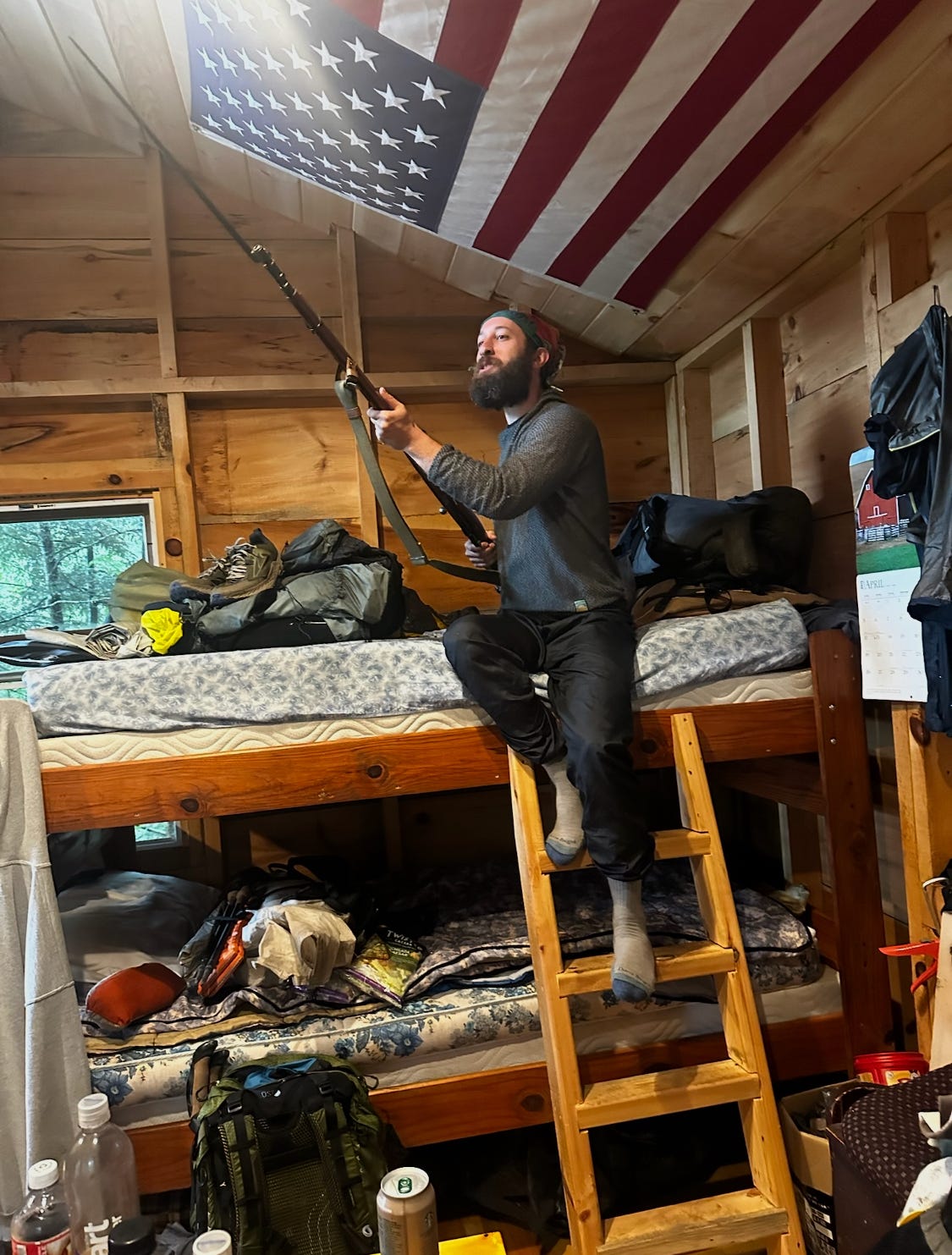
Jackson O’Brasky is a painter in Ridgewood, New York. In 2024 he hiked the Appalachian Trail with help from the Elizabeth Greenshields foundation. He doesn’t know I wrote this bio for him or used this photo. You can find his paintings on his instagram @jackson_obrasky or on his website.